On Monday, January 12, 2026, Judge Royce Lamberth (a Reagan appointee) of the U.S. District Court for the District of Columbia issued an injunction order, which blocked a Trump administration stop-work order on the offshore Revolution Wind project, allowing construction to resume. Judge Lamberth had earlier overturned the administration’s August order halting the 65-turbine, $6.2 billion project.
Two Federal Judges Are Acting to Stop the Administration’s Halt Orders.
The January 12, 2026, Judge Lamberth injunction order related to Revolution Wind’s offshore project follows a December 8, 2025, decision by U.S. District Court Judge Patti B. Saris of the District of Massachusetts that granted summary judgment against the Trump administration declaring that the president’s January 20, 2025, executive memorandum directing federal agencies to halt wind energy development, and all related agency actions to implement the memorandum, were unlawful.
The Judge Saris summary judgement decision came in the case filed on May 5, 2025, by 17 states and the District of Columbia, challenging the Wind Memo. The complaint asked the court to declare that each of the agencies’ actions to adopt and implement the Wind Memo are arbitrary and capricious in violation of the APA; that the actions are not in accordance with law or are in excess of statutory right in violation of the APA; and that the actions are otherwise ultra vires.1
Then, Judge Lamberth followed suit addressing the Revolution Wind project off the coasts of Connecticut and Rhode Island. The January 12, 2026, Order by Judge Lamberth states:
State Plaintiffs [ i.e., Rhode Island, Connecticut, and Katherine Dykes ] are entitled to a stay and preliminary injunction of the Bureau of Ocean Energy Management’s December 22, 2025, Order issued to Revolution Wind “to suspend all ongoing activities related to the Revolution Wind Project on the Outer Continental Shelf for the next 90 days for reasons of national security” (the “Second Stop Work Order”). Furthermore, the Court finds that the State Plaintiffs are entitled to a preliminary injunction against the enforcement of the Second Stop Work Order.
The State Plaintiffs have demonstrated likelihood of success on the merits of its underlying claims, they are likely to suffer irreparable harm in the absence of an injunction, the balance of the equities is in their favor, and maintaining the status quo by granting the injunction is in public interest. (Emphasis Added)
The Revolution Wind project is one of five coastal wind developments that were halted in December 2025 by the Trump administration. In implementing the president’s Wind Energy Executive Memorandum, the U.S. Department of Interior had cited a classified report from the U.S. Department of Defense arguing that the wind turbines could disrupt military radar.
Judge Royce Lamberth reviewed the classified report and focused, in part, on the fact that it took Interior a month to act on DOD’s findings. That fact, alone, suggested to this particular judge that the threat was not as grave as the government claimed. The judge continued and commented that, when DOI ultimately acted, the government failed to properly explain its rationale. In the Court’s words: those actions were “unreasonable and seemingly unjustified change in position.”
In open court, Judge Lamberth had stated,
The balance of equity is clearly cut in favor of Revolution Wind continuing work while the government considers ways to mitigate any new national security concerns that the project may implicate.
Other Offshore Wind Energy Projects Are Affected.
The Judge Lamberth decision is a significant win for Revolution Wind and other offshore wind projects. Federal agencies have proposed revoking permits for projects approved under the Biden administration and had earlier temporarily halted construction of the Revolution Wind project and the Empire Wind project – a 54-turbine project serving New York.
Here are only two examples of projects affected by agency actions and the resulting court orders.
The Revolution Wind project is a 704 MW offshore wind farm under construction off the coast of Rhode Island and is targeted to supply wind energy to Rhode Island and Connecticut by 2026. The project will send power to over 350,000 homes and create thousands of jobs. Developed by Ørsted and Skyborn Renewables, it is the first multi-state offshore wind project in the U.S.
The Empire Wind project is being developed in two phases:
Phase 1: Located south of Long Island, the first phase of Empire Wind started construction in 2024. The installation of the first of 54 foundations took place in Spring 2025. Empire Wind is expected to reach its commercial operation date in 2027. The 54 turbines will produce 810 MW.
Phase 2: The second phase of Empire Wind is under consideration for future offtake agreements and would be located directly behind the first phase of Empire Wind. This space has the potential for an additional 84 turbines delivering 1,260 MW.
Wind Power in the U.S.
The U.S. Department of Energy data shows that wind and solar power were two of the fastest-growing energy sectors in the U.S. and produced as much as 17% of the country’s electricity in 2024.
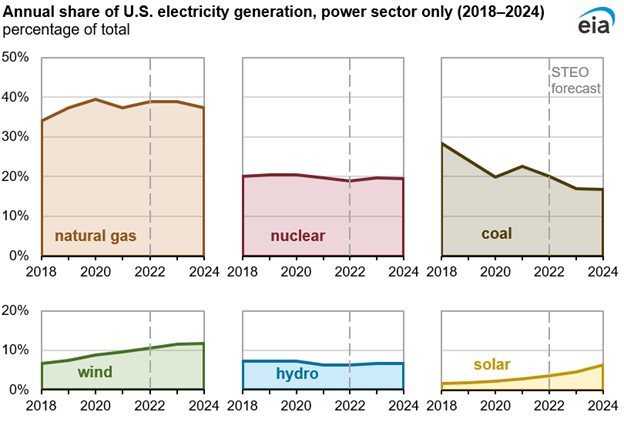
2
What Now? Stay tuned.
Offshore wind power projects in states from Massachusetts to Virginia, if built, are expected to collectively generate enough electricity for 2.7 million homes every year. It is unclear what Judge Lamberth’s injunction will mean for other projects halted by the Trump administration. One can only wait and see what turmoil is caused by further federal agency actions.
This blog was drafted by John L. Watson, an attorney in the Spencer Fane Denver, Colorado, office. For more information, visit www.spencerfane.com.
—
1 See this author’s earlier articles regarding the District of Massachusetts’ litigation: a December 10, 2025, blog that discusses the Court’s decision. See also this author’s May 7, 2025, blog discussing the underlying complaint in the Massachusetts’ lawsuit filed by the 17 states.
2Source: Data source: U.S. Energy Information Administration, Short-Term Energy Outlook, February 2023
Data values: U.S. electricity generation
Note: The six energy sources shown accounted for at least 98% of annual electricity generation from the electric power sector during this time period.
See Short-Term Energy Outlook – U.S. Energy Information Administration (EIA)
Click here to subscribe to Spencer Fane communications to ensure you receive timely updates like this directly in your inbox.