Since 1920, nuclear power generation in the U.S. has evolved from experimental physics to a major component of the national energy grid. Significant technological breakthroughs and regulatory changes have triggered a modern resurgence.
This article is the first of two on nuclear energy in the U.S. Part 1 provides an overview of the current use of nuclear to generate electricity in the U.S.; outlines a list of the major milestones in its development; and reviews federal policy changes over the years. Part 2 will discuss current technologies and projects that are shaping the industry.
The Current Status of the Nuclear Power in the U.S. According to the U.S. Energy Information Administration, nuclear power is projected to maintain a consistent 18% share of U.S. electricity generation in 2026, similar to 2025 levels. While the overall consumption of electricity in the U.S. has hit record highs, nuclear power generation is a major component of the low-carbon energy mix.
| Shares of U.S. Electricity Generation1 | |||
| Source | 2025 | 2026 | 2027 |
| Natural gas | 40% | 39% | 39% |
| Coal | 17% | 16% | 15% |
| Nuclear | 18% | 18% | 18% |
| Conventional hydropower | 6% | 6% | 6% |
| Wind | 11% | 11% | 12% |
| Solar | 7% | 8% | 9% |
| Other energy sources | 1% | 1% | 1% |
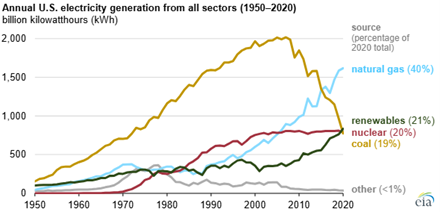
The EIA provides a succinct history of the industry at its website. Here are some of the milestones since 1942.
- Chicago Pile-1 (1942): Led by Enrico Fermi, scientists at the University of Chicago achieved the first self-sustaining, controlled nuclear chain reaction, proving the fundamental principle of nuclear power.
- Atomic Energy Act (1946): This federal legislation established the Atomic Energy Commission (AEC), transferring control of atomic energy from military to civilian hands and setting the stage for peaceful applications.
- Experimental Breeder Reactor-I (1951): Located in Idaho, EBR-I became the first reactor to generate usable electricity from nuclear fission, initially powering four light bulbs and eventually its entire building.
- “Atoms for Peace” Program (1953): President Dwight D. Eisenhower’s proposal reoriented nuclear research toward civilian electricity generation, leading to the development of commercial reactor designs.
- Shippingport Atomic Power Station (1957): Commissioned in Pennsylvania, Shippingport was the first full-scale nuclear power plant in the U.S. dedicated exclusively to peacetime electricity production.
- Energy Reorganization Act (1974): This federal statute abolished the AEC and created the Nuclear Regulatory Commission (NRC), separating the regulation of nuclear safety from the promotion of nuclear energy.
- Three Mile Island Accident (1979): A partial meltdown at this Pennsylvania plant became the most significant accident in U.S. commercial nuclear history, leading to sweeping changes in emergency response and safety regulations.
- Energy Policy Act (2005): This federal statute provided significant federal incentives, including production tax credits and loan guarantees, aimed at sparking a “nuclear renaissance” in the U.S.
- Vogtle Units 3 and 4 (2023-2024): The completion of these units in Georgia marked the first new reactors built from scratch in the U.S. in over 30 years, representing the first deployment of Gen III+ AP1000 technology. With an original budget of $14 billion, the final cost for the plants reached approximately $36.8 billion and took 15 years to build. The costs were passed to Georgia ratepayers through higher electricity bills.
- Restarting Retired Reactors (2025-2026): In what is recognized as the historic shift for the nuclear industry in the U.S. in 2025 and 2026, major tech companies and utilities announced plans to reopen retired nuclear plants, such as Three Mile Island Unit 1 (which has been renamed Crane Clean Energy Center) and Palisades in Michigan, to meet massive data center energy demands.
Federal Policy Shifts. In early 2026, the convergence of federal policy shifts and massive private investment is rapidly accelerating the deployment of nuclear energy for industrial use.
Regulatory Changes for Faster Deployment. To meet the goal of significantly expanding U.S. nuclear capacity, both the Biden and Trump administrations have implemented several landmark legislative and regulatory reforms.
- The Biden Administration’s ADVANCE Act (2024): As explained on the NRC website:
The ADVANCE Act of 2024 was passed with bipartisan support and signed into law in July 2024. It requires the NRC to take a number of actions, particularly in the areas of licensing of new reactors and fuels, while maintaining the NRC’s core safety and security mission. The Act affects a wide range of NRC activities, including by supporting the recruitment and retention of the NRC workforce, adding flexibility in the NRC’s budgeting process, enhancing the regulatory framework for advanced reactors and fusion technology, and requiring initiatives to support the NRC’s efficient, timely, and predictable reviews of license applications.
In part, the statute will reduce regulatory fees for advanced reactor applicants starting in FY 2026 and will implement a “rewards” system to incentivize and develop new technology.
- 10 CFR Part 53 (to be finalized in March 2026): As early as 2023, the NRC began development of a new, technology-inclusive licensing framework. Unlike older rules, the new program is performance-based, allowing engineers to prove safety through data rather than following rigid, decades-old design prescriptions. See the NRC website.
- DOE Reactor Pilot Program: The U.S. Department of Energy (DOE) developed a fast-track pilot program whereby specific advanced reactors can achieve “criticality” at non-federal sites as early as July 4, 2026, bypassing some traditional NRC licensing steps for initial testing.
- Brownfield Redevelopment: In September 2025, the NRC submitted its report to the U.S. Congress addressing the matters specified in Section 206(b) of the Biden administration’s Advance Act which requires the NRC to implement strategies or a rulemaking to “enable efficient, timely, and predictable licensing reviews for, and to support the oversight of, production and utilization facilities at brownfield and/or retired fossil fuel sites.” New rules would be designed to simplify the environmental review process for building nuclear plants on retired coal or fossil-fuel sites, with the objective of leveraging existing grid connections to avoid years of construction time.
Trump Administration Executive Orders. On May 23, 2025, President Trump signed four Executive Orders (EOs) aimed at quadrupling U.S. nuclear capacity to 400 GW by 2050 by accelerating licensing, reforming the NRC, and boosting fuel supply. The orders focus on speeding up reactor deployment, particularly for AI infrastructure, and enhancing national security.
- Ordering the Reform of the Nuclear Regulatory Commission(EO 14300): Directs the NRC to modernize its culture, streamline licensing, and reduce bureaucracy to accelerate approval of reactor designs, with a goal of evaluating new licenses within 18 months.
- Reforming Nuclear Reactor Testing at the Department of Energy(EO 4301): Establishes a DOE test reactor pilot program to expedite the review, approval, and deployment of reactors at DOE and national lab sites.
- Reinvigorating the Nuclear Industrial Base(EO 14302): Focuses on strengthening the domestic nuclear fuel cycle, increasing uranium conversion / enrichment, and encouraging nuclear workforce development.
- Deploying Advanced Nuclear Reactor Technologies for National Security(EO 14299): Directs the U.S. Department of Defense, to operate a reactor at a domestic military base, increases nuclear technology exports, and establishes the National Environmental Policy Act categorical exclusions for reactor construction on federal sites.
AI Data Center Impacts. By 2026, the International Energy Agency (EIA) projects that global data center electricity consumption will reach 620-1,050 TWh, contributing to an estimated 290-490 million tons of carbon emissions globally. A report prepared by the Union of Concerned Scientists states that, “Without stronger clean energy policies, the additional fossil fuel generation used to power data centers results in an increase in annual U.S. power plant emissions of carbon dioxide (CO2) of 19 to 29 percent (229 to 342 million metric tons – MMT) by 2035.”
And the Environmental Benefits of Nuclear Power? Natural gas is the dominant alternative to provide reliable 24/7 power to the grid. In 2026, the environmental impact of nuclear energy for data centers is increasingly quantified by the “carbon avoidance” it provides over natural gas. The World Nuclear Association reports:
nuclear power plants have a very low lifecycle carbon footprint, typically ranging from 3.7 to 110 grams of equivalent per kilowatt-hour. They produce zero emissions during operation. While acknowledging that there are GHG emissions that arise from mining, construction, and decommissioning, overall, nuclear power’s footprint is comparable to wind and lower than solar, making it one of the lowest-carbon energy sources. Stated differently, nuclear produces about the same amount of carbon dioxide-equivalent emissions per unit of electricity as wind, and one-third of the emissions per unit of electricity when compared with solar. Id.
At its website, DOE summarizes the environmental benefits of nuclear power:
Nuclear is the largest source of clean power in the United States. It generates nearly 775 billion kilowatthours of electricity each year and produces nearly half of the nation’s emissions-free electricity. This avoids more than 471 million metric tons of carbon each year, which is the equivalent of removing 100 million cars off of the road.
Now on to Part 2. With that as prelude, Part 2 will discuss current technologies and projects that are shaping the industry.
This blog was drafted by John L. Watson, an attorney in the Spencer Fane Denver, Colorado, office. For more information, visit www.spencerfane.com.
—
1 https://www.eia.gov/pressroom/releases/press582.php
Click here to subscribe to Spencer Fane communications to ensure you receive timely updates like this directly in your inbox.